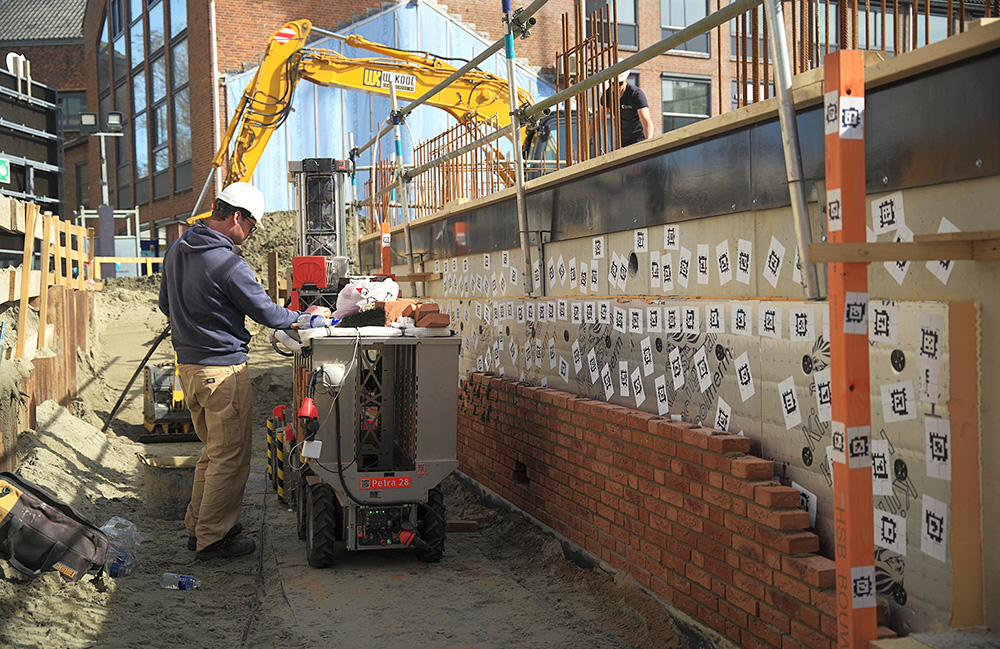
America’s housing industry is under pressure to build more homes with a shrinking pool of skilled labor. Robotics and automation offer one potential answer, but the biggest gains so far are not coming from humanoid robots replacing workers on construction sites.
They are coming from narrower applications: machines that prevent mistakes, coordinate trades, and automate repetitive work, along with factories that move more of the construction process into controlled environments, say industry experts.
The United States is short roughly 1.2 million homes, according to the National Association of Home Builders 2026 Housing Outlook. Nearly 300,000 construction jobs remained open at the end of 2025, and NAHB estimates the industry needs to attract roughly 740,000 workers a year to account for growth, retirements, and workers leaving the field.
That labor gap compounds a decades-old productivity problem: Residential construction productivity has increased only about 16% since 1993, compared with gains of more than 50% across the overall economy, according to NAHB chief economist Robert Dietz.
Labor shortages alone cost homebuilders about $11 billion a year through higher costs and lost production and add roughly two months to the average construction timeline, Dietz said.
Yet when asked whether robotics is already meaningfully improving homebuilding productivity, Dietz said, “It’s too early.”
“There’s no single, simple, scalable solution,” he said, pointing to labor, regulatory costs, land availability, supply chains, and financing as additional constraints on housing production.
The results so far suggest robotics can produce meaningful gains on individual projects, but those gains remain too narrow and too limited in scale to materially reduce the national housing shortage.
Why robots still struggle on construction sites
Unlike a factory, a construction site changes every day.
Tessa Lau, founder of Dusty Robotics, spent years working in robotics before turning to construction. She said factories are relatively easy to automate because robots can perform the same task repeatedly in a fixed environment. Construction is the opposite: The robot’s workplace is literally being transformed around it.
Patrick Murphy, chief investment officer of Florida-based Coastal Construction, sees the same problem from the builders’ side. Every project can involve different designs, soil conditions, architects, subcontractors, materials, and owner requirements, he said, explaining that the lack of uniformity makes repetitive automation difficult.
That variability helps explain where the measurable gains are showing up. Vineet Kamat, a University of Michigan professor who studies construction robotics, said the clearest results today are in highly repetitive, well-structured tasks, including layout, factory automation, and task specific applications such as drilling, fastening, and material handling.
The biggest benefits, he said, are not full labor replacement but improved precision, fewer errors, and greater throughput.
“The key question is not whether a robot can work in a pilot,” Kamat said, “but whether it can do so reliably across varied conditions with a positive business case.”
But Murphy said the popular image of construction robotics is well ahead of that reality. “The biggest misconception is people imagining humanoid robots walking around job sites hanging drywall and painting. We’re years out before we’re in that world.”